Friday, November 13, 2009

Sunshine Cleaning (Jeffs)


For all its claims to being a realistic look at life for a working class single mum in small town America, Sunshine Cleaning is a fantastical, revoltingly glossy film that looks down on its characters and their predicaments. When Rose decides that her son's route to happiness and success is dependent on him going to private school, she enlists the help of her slacker sister Norah and together they decide to set up a crime scene clean up company to raise funds. The narrative briskly sidesteps the problems a woman such as Rose might encounter in setting up a business, racing on to plenty of jovial icky moments about how awful it is to clean up the blood of a recent suicide. There's also time for philosophical reflection that work in this industry leads one to consider: "it feels wrong that we're throwing everything away - it's like we're erasing her".

Whenever the sisters walk into a house that appears to need an arduous and tiring clean the filmmakers quickly utilise the Sundance aesthetic of bright lights, snappy edits, and indie soundtracking to montage their way out of darker territory. There's a similarly clinical feel in the continual striving to balance moments of humour with a sadder, more wistful tone that quickly saps all energy from the narrative. The characterisation is paper-thin and dreadfully tiresome, with the requisite fuckups and breakdowns appearing at exactly the moment you'd expect. This facile and inane drama is aimed squarely at the middle classes, purporting to reveal what life is like for those on the bottom, but ensuring that they be beautiful, upwardly mobile people for whom success and happiness is easily achievable if only one can believe in the American dream.

Friday, October 16, 2009

Interview With Pedro Costa


Pedro Costa was in London earlier this month to coincide with a period of increasing interest in his work. His debut feature Blood (1989) was recently released by Second Run on DVD and a complete retrospective of his films was held over two weekends at Tate Modern. Such a retrospective is the ideal setting for these beautiful and challenging films, particularly as a means to track the stylistic developments and common threads that run throughout his career.

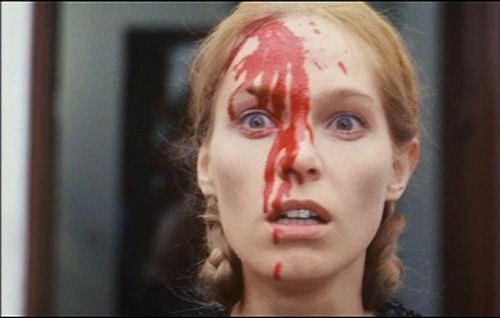
Blood is Costa's most classical film, a noirish tale shot in rich chiaroscuro that channels the spirit of many of the director's influences, from Murnau to Tourneur to Bresson, and introduces the interest in families and place that pervades each of his films. Costa's focus has since turned towards the poor immigrants from the former Portuguese colony of Cape Verde and the Fontainhas slum on the outskirts of Lisbon where many of these people were subsequently relocated to.

After Down to Earth (1994) and Bones (1997) Costa moved away from using a full film crew and went to stay with some of the people living in Fontainhas for long stretches of time, filming hundreds of hours of footage over many months as they played semi-fictionalised versions of themselves. This led to In Vanda's Room (2000) and Colossal Youth (2006), two masterpieces that magically and devastatingly transform truth and fiction into new realms, creating a blisteringly direct portrait of a community whose inhabitants still retain their mystery.

Costa has also made two documentaries. Where Does Your Hidden Smile Lie? (2001) observes Jean-Marie Straub and Daniele Huillet during the editing process of their film Sicilia! and his most recent film is Ne Change Rien (2009), which follows the French actress and singer Jeanne Balibar as she rehearses, records an album, and performs her music live.

Do you enjoy attending retrospectives and talking about your films?


Yes, because when you talk about something you learn a lot and find yourself saying things you'd never thought about. I try not to be repetitive and instead go a little bit further and try and discover something new. In a situation like this retrospective at the Tate I'm relating and making connections between the films so that's nice for me too, and is one of the best parts of having the films shown together.


So it becomes part of the process to help you move on to the next film?


That's especially true in my case because my films are now like Chinese boxes. There's an obvious connection because I use the same people and shoot in the same place. Sometimes I discover there was something I'd never thought about at length, where just a word in a film can give you an idea. It's a little bit like how with Colossal Youth the French title is not that at all, it's Youth on the March. For me that's like a metaphor of the process, walking and thinking. Making films is also a way of walking. It's nice to have a programme that's not only for the audiences but also for me, even if I don't see the films themselves.


Do you ever go back and watch your own films?


I never watch them again. There's only one I'm more or less comfortable watching, and that's the film I made about Straub and Huillet. I can always learn from them.


Did you go to film school?


I was in film school when I was young but I hated it. I went there to learn about lenses, editing, how things work, but not theory or film history. I don't think film history is the crap we've been told. You read that Chaplin is old or that there is a chronology. With theory of course there are great people writing, but sometimes it's not the film critics, it can be a philosopher, sometimes it’s a musician, or maybe it's a poet that gives us the best text.


What were your interests growing up?


My first project was music. I was lucky when I was younger because there were a lot of things happening, the excitement of so many great bands with great lyrics. At the time the experience of listening to something by Wire and PiL was amazing. It was like seeing a Godard film. It was another world where you would get out of the movie theatre. It was a time when the person next door would probably do something amazing, but it wasn't a commercial competition. There was also a political revolution in Portugal at the same time, where the fascist dictatorship ended and the streets were full of anarchists, communists, and socialists, so from the ages of 13 to 22 I had everything, the music, the cinema, the politics, all at the same time. What this made me see was that John Ford was a hundred thousand times more progressive and communist than so called left wing documentaries saying things like “film is a gun”, and “change the world”. It was Ozu and Mizoguchi and Ford that were saying that really, you just had to be patient and see it well.


What was about these filmmakers that inspired you?


I'm very attached to a beautiful formula written by Serge Daney, one of the best French critics who I had two or three classes with in Lisbon. He said that with the movies that we like, it is the films that see us. Of course it is you that is watching the film, but the film sees you, it watches you grow up. The film tells you something, to live this way and talk that way. I knew I would like to live in the worlds that some filmmakers showed me, and I could also see immediately that certain films were not for me, because they weren't watching me. It's a very beautiful formula, maybe a bit vague or poetic, but you feel it immediately. Films by Straub and Godard knew what I was feeling. It's something you recognise, it's like a sect, a club. You feel like you belong to this club and not the other one. With my own films it's the same feeling. If it feels right it is like the images and the sounds are watching you and protecting you, showing you the way to do this or that. It's not the script, it's not your ideas. It's something more real and integrated and in time. It's more in life.


How did you come to make Ne Change Rien?


I thought this film was going to be very special and different from the others I've made, but in the end the ideas and the form are not really so unlike all the things I've been doing. It began as a friendship with Jeanne Balibar. We met seven or eight years ago at a film festival. We were always watching films together and discovered a common sensibility, and then one day she asked me to do a video for a song off her first album. The idea then came for me to be there while she was rehearsing. When I filmed her in concert I didn't want to do a film like Shine a Light with the camera turning upside down, and I wasn't interested in doing a 'making of' that you have on DVDs with guys in the studio telling jokes and drinking beer.


How did your approach for this film compare to the documentary you made about Straub and Huillet?


When I was there with Jeanne and the musicians I had the same approach as with the other film, discreetly moving around with very small equipment, being really close without disturbing them and trying to keep an eye on what's happening in the microsecond. It's so small that the moment where you cut is the time when something happens. It's so small that you miss it. For both films it was the same fascination because I was watching people I like. What I'm doing is turning these guys into monuments. It's almost like doing a fiction film because you want them to come out so good, like actors, where you can cut off all the bad parts and the things they don't do so well. I want Straub and Balibar to be bigger than life, bigger than themselves and bigger than the image you have of them. The structure I made is very fictional because they have to come out like heroes, like the great people I always thought they are, and there was no disappointment.


What was the shooting process like for In Vanda's Room and Colossal Youth, the two films you've made without a film crew?


The shooting takes a very long time, and this changes everything for me. For Colossal Youth we shot every day for two years except on Sundays. I felt for the first time in my life like I was working. I made my first films in five or six weeks and it was a luxury environment I was uncomfortable with. I thought I was too slow to make a film in this time. I always had the feeling that in the last week of shooting I would begin to start discovering the film, realising that we had done everything wrong, so I would have to be asking the producer to give me two or three more days. Of course it's not that I'm really a slow filmmaker, but that I just don't want the shooting to end. I want the complication of life to be a part of the film, to make the film. When we started filming Colossal Youth Vanda told me she was pregnant, and a year later her child ended up appearing in the last shot of the film. Of course you can't script this or suggest such an idea to a producer!

How did you persuade the inhabitants of Fontainhas to let you stay with them and film them for so long?

I had to show them that the film could be possible in another way, without a film crew and the trucks and the money, that it could be possible for me alone with a camera. They had to see how difficult it was for me. They had to see that I came at 9am when they opened the coffee shop and the barber shop and that at 7pm I would close the door. I had to show them it was a common street. That was decisive.


Did you feel conflicted about making In Vanda’s Room when there are so many drugs around?


Vanda has been into drugs since she was 15 and it's something you can't avoid. It's daily life. She smokes heroin and cocaine like I smoke cigarettes, so if you're with her for an hour you have to see it. For me as a filmmaker, there was a moment where there was an ethical problem that I dealt with silently and alone, asking how it could be done. It's not that I want to show the drugs, but I cannot avoid it, and so In Vanda's Room tries to be something else in terms of production and organisation. I am trying to do something more human though. It was not going to be a film about drugs. It was about the place, about the room, about a kind of family and a world seen through my eyes. It's not the real Fontainhas or the real Vanda, but it's my eyes seeing her and her watching me. A lot of people dislike In Vanda's Room because they don't feel I have the right to film those people that way. I've been accused that the film is too beautiful and criticised because we don't explain how they get the money to buy drugs, but that's simply because money doesn't have a value there. They don't have money and so they have to find it, and normally they find the money and then they spend it immediately on drugs. It goes up in the air.


In most films that show junkies the camera will start turning as soon as they start smoking and we go into this daze and the characters get stupid. For me this was not the case. They were always thinking about serious things. I did not think and plan all this. I just said let it be, knowing that drugs will be there for Vanda and for a lot of people, but taking care that we were not going to make films like anyone else and that these people will think and talk like other people. A lot of documentary filmmakers think you have to make an ugly film, that ethically I have no right to turn them into heroes, but that's what I wanted. The lesson I learnt from Chaplin and Ford is that people have to walk out better than they walk in. Ventura has to be bigger than John Wayne.


How do you determine the right distance to keep when you're filming?

I don't believe a camera can solve or discover the mystery of anybody. It's very fake, so I don't pretend I'm close. The distance I keep is just a focal thing, it's not meant to say I know this person and I want you to feel how he's feeling. In the case of Ventura the distance is something I cannot avoid. I could never say I understand him or I know what he felt. I'm not black like Ventura or from the same social class. I was not born on Cape Verde and I've never been 20 years into taking Cocaine, and they tend to tell me that every second. He said to me at the end of shooting very simply, “don't ever think you can know me because you have a camera”. I think that's one of the best principles and lessons you can learn to make film, to think about the distance that will be created between you and what you want to film, and perhaps accepting that it’s very wide between me and him, a deep and long everlasting ocean of mystery that neither of us will cross. But of course that doesn't mean that he's not interested in the work. It doesn't mean that we're not friends.


Do you plan to work with these people again?


It's their expectation. When a film is almost over we're ready for the next one. It's about them demanding something, and I've no reason to go away. I think my next film with them will be about young kids, a younger generation. In the last shot of Colossal Youth Ventura is lying on a bed more or less moaning something and Vanda's newly born daughter is beside him making some sounds, and I thought that this is probably a good dialogue. I take it as a sign that Ventura finally rests and this new face appears and has this strange coded language that we don't understand.


Can you speak about the films you chose to accompany the retrospective at the Tate?


If I do this kind of thing it's about giving the viewer tools that are really proposals saying 'you can do a film this way'. In the case of Jean-Pierre Gorin's Routine Pleasures it's a shoestring budget, two guys and that's it. With the Jean Eustache film The Pig you see the most amazing way of watching a very ancient ritual of killing a pig, and you see it's really about the people, not about the animal. I chose Straub for more practical reasons, because Sicilia! is the film that I documented the editing of in Where Does Your Hidden Smile Lie? Straub and Huillet are the filmmakers that give you the feeling that films are meant to be worth something. The Warhol film I show is called Beauty, a film I saw recently and it's just like In Vanda's Room, the difference being that he made it without thinking for one second whereas I took two years of pain and blood.

Monday, August 10, 2009

Notes on Zabriskie Point

Beauty

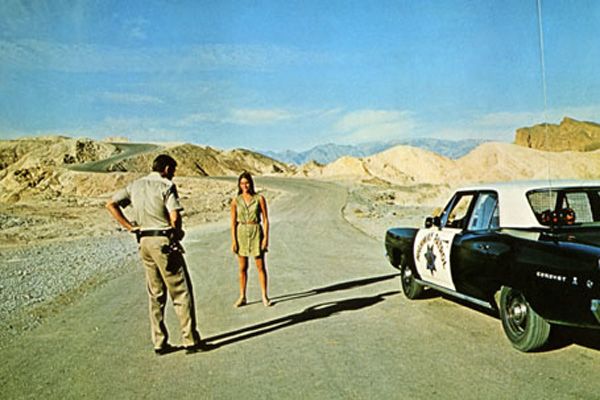
Zabriskie Point is a film of astonishing beauty. Antonioni has the ability to place a series of landscapes, objects, or (most importantly) faces in a majestic arrangement of patterns that send me into an oneiric trance. The success of his films depend on this, because it’s essential that the dreamy turns his narratives take (orgies in the desert, exploding houses, magically appearing men with magically appearing cans of paint) appear natural to the development of the film, so that these ruptures aren’t an abandonment of narrative logic but work as a development of Antonioni’s unique mode of storytelling. Narrative is not left behind in his films; it just heads to unexpected places. One becomes wowed by the beauty the frame contains, and astonished by the way Antonioni frames it, so that the car, the mountains, hair, fire, a TV set, and on and on, all become interchangeable. A landscape is a face, a face is an object, an object is a landscape.

Acting

Are Mark Frechette and Daria Halprin bad actors? It depends on your definition of the word bad. There’s no doubt that the way they move through the landscape feels unreal, that their voices are stilted and that most traces of charisma have been scooped out of them. But if we see them less as actors and more as models, their casting makes perfect sense. Mark and Daria are important because of what they represent, not because of what they are. It is essential that they behave as vacantly as the faces adorning the endless billboards in the city and as blank as the parched landscape of Death Valley.


Escape


Zabriskie Point is deeply concerned with the futile desire to escape. Wherever these bodies move, Antonioni ensures that they are always folded into a landscape or set off against it. In the city their bodies are framed in tight close up, the camera whizzing past people as they mesh together in a haze, whilst their voices swell to one long, unrelenting rumble. The city is jammed full of adverts, on billboards and TV and radio, rendering all bodies lost in a sea of information. The move to the desert leads the camera further away and higher up, turning them into insects as they yet again disappear into their surroundings.

Suspense


The famous scene from North By Northwest in which Cary Grant is attacked by a mysterious jet in a vast expanse of Indiana countryside finds its modernist echo in Zabriskie Point. The suspense is drained. Animated peril transforms into a vacant smile.

Utopia


Is the desert a utopia? This article published in Senses of Cinema suggests so, and tends to reduce the film into a series of binary oppositions in which the city/cops = bad and desert/students = good. This sort of attitude not only dampens the power of this film but short changes the complexities within. For sure the film falls cleanly on the side of the students, but Mark’s boyish adventure into the desert is hardly a revolutionary act. Daria prefers to listen to rock music than be politically active, and her final act of defiance is shrouded in fantasy. There are policemen in the desert and students in the city, and while the orgy takes place there is a reality that exists a few miles away.

Endings

Reaching out towards a pure cinema:


Friday, July 31, 2009

The Ontology of the Photographic Image

The cinema is objectivity in time. The film is no longer content to preserve the object, enshrouded as it were in an instant, as the bodies of insects are preserved intact, out of the distant past, in amber. The film delivers baroque art from its convulsive catalepsy. Now, for the first time, the image of things is likewise the image of their duration, change mummified as it were. Those categories of resemblance which determine the species photographic image likewise, then, determine the character of its aesthetic as distinct from that of painting.

from What is Cinema by Andre Bazin

Thursday, July 16, 2009

All Over Me (Sichel)


All Over Me was screened at the ICA this month as the final film in the inaugural Pout Film Festival, timed to coincide with Pride London and aspiring to showcase the best of queer cinema. Originally released back in 1997, it’s the first and (as far as I can tell) only film directed by Alex Sichel, which seems a real shame considering this coming of age tale possesses an earnestness and intelligence that’s sorely lacking in a lot of recent American Indie filmmaking. Portrayals of sexually confused adolescents are highly prone to verge on the side of caricature and cliché, so it's refreshing to witness such assured characterisation, mainly thanks to a witty, sensitive script and a superb central performance from Alison Rolland. Rolland acts out scenes with a wonderful complexity that nails the swelling of emotion teenagers feel as they explore their sexual feelings.

Rolland plays Claude, a teenager living in New York who divides her time between working in the local pizza shop and hanging out with her best friend Ellen. They spend their evenings listening to the riot grrrl records that soundtrack Claude’s life as she tries to get together a group of her own. The arrival of two men send the friends down different paths. Ellen becomes involved with a cruel, possessive boyfriend while Claude's new next door neighbour is a gay guy who sparks an assertion of her queer identity. Ellen’s life falls apart as she takes ever increasing amounts of drugs and becomes witness to a too-predictable crime that occurs after the two men meet. Claude wants to save her friend, but is beginning to strike up a relationship of her own.

The film’s low budget works to its advantage for the most part, with a small cast, minimal locations, and basic camerawork ensuring the main focus is on a realistic portrayal of Claude and Ellen’s psychology. Unfortunately it hinders when the film intermittently resembles a half hearted pot-boiler that stretches both narrative credibility and the acting ability of some of the supporting cast.

The most refreshing aspect of All Over Me is that it refuses to allow its characters to be reducible to categories. There are no cool people and no nerds here. The result is that Ellen and Claude are opened out, able to live and breathe as they try to find their way in the world.

Monday, June 29, 2009

Wonderful Town (Assarat)


Wonderful Town tells a well worn tale of a love affair that's pulled apart by a jealous relative. Set in Takua Pa, a Thai town that was devastated after the 2004 tsunami, the relentlessly slow manner in which the romance blossoms is painful to behold, lacking the passion, intensity, and transcendence a film this sparse demands.

The two leads are defined by their occupations. Ton is an architect who is sent to the town to oversee the construction of a new building. A constant traveller, he has a freedom that is distinct from Na, who lives in and runs her family's mostly empty hotel, leading a lonely and insular existence. Her brother is a washed up ex-gangster who seemingly has nobody left to terrorise in Takua Pa's empty streets.

Thin on dialogue and glacially paced, the film struggles in vain to accrue power through weakly developed symbolism (waves, roads, empty houses) that never feels appropriately connected to the narrative, existing merely as a way to fill the void that lies at its heart. The violent twist in tone in the final minutes is similarly incoherent and evidently a means to provide a jazzy finish to the uninspired hum that precedes it.


Sunday, June 28, 2009

A Day At DC's

Here's a link to a post that I assembled for Dennis Cooper's blog, in which I assembled a selection of some of my favorite short films. He's a writer who's not only published some of the greatest American fiction I've ever read, but created a blog that's one of the most exciting and rewarding places to hang out on the net.

Wednesday, June 03, 2009

The Mongrel Muse

Ever since the cinema began, aestheticians have sought to define 'pure cinema', the 'essence' of cinema. In vain. The cinema's only 'purity' is the way in which it combines diverse elements into its 'impure' whole. Its 'essence' is that it makes them interact, that it integrates other art forms, that it exists 'between' and 'across' their boundaries. It is cruder and inferior to every other art form on that form's 'home ground'. But it repairs its deficiencies, and acquires its own dignity, by being a mixture.

from Films and Feelings by Raymond Durgnat

Tuesday, June 02, 2009

Sparrow (To)

Closing this years Terracotta Far East Film festival, Sparrow is a light and madcap buddy movie in which a group of petty thieves come to the rescue of a woman in the clutches of a rival gang. Cartoonish characterisations and a lack of cohesion in tone and pacing don't deter, imbuing the movie with a fun and freakish quality that's frequently engrossing.

Directed by the ever prolific Johnnie To, who here eschews his more typical violent gangster films for a foray into calmer territory, Sparrow was a personal project that was shot on and off over a couple of years in between other films. It's evident that To is deeply attached to the fast developing Hong Kong that serves as the setting, the shooting of the film acting less as a way for him to tell a story than as a means for him to document and preserve a city as it fades from being the recognisable home he once knew.

A sparrow is both a slang term for a pickpocket and a symbol of bad luck, so it's unsurprising that soon after one flies into and then settles in pickpocket Kei's living room, a series of unfortunate events unfold for him and his friends that make up the criminal gang. They each become seduced by the charms of the same woman, finding themselves inexplicably drawn to her, and ending up with a whole host of injuries, faces bandaged and arms broken. It turns out that she's desperate to escape the clutches of her lover Mr Fu, the head of a rival pickpocket group, and the plot proceeds to a showdown between them. For large patches the film proceeds without dialogue and tends to opt for fun slapstick scenarios, most notably a series of chase scenes, one of which culminates with all parties trapped in a lift, playing hide and seek amongst a bystander carrying a precariously balanced fish tank.

Key to the film's success is the score by Fred Avril and Xavier Jamaux in which they provide a swooning jazzy soundtrack that sustains itself throughout the whole picture. Sparrow contains a nod to Umbrellas of Cherbourg in its final sequence, and it too feels like a musical, not just by virtue of the ever present soundtrack, but also thanks to the insistent rhythms to which the characters shuffle. In the extended final showdown between the two groups, the action is slowed down and edited to make the characters glide across the rain soaked streets in time to the score.

It's very easy to get immersed in To's world thanks to his inventive and highly charming style that tends to successfully smother the paper thin characters and run of the mill plot. Sparrow is a fun and dreamy ride, albeit a forgettable one.

Friday, May 15, 2009

Elevator (Dorobantu)

George Dorobantu’s debut feature is a short, not too sharp drama about a couple of Romanian teenagers who find themselves holed up in the broken down lift of an abandoned factory after they go there to make out.

Made for only €200 and set entirely within the four walls they’re trapped in, Elevator suffers from an inability to work a way out of its financial restrictions, opting for weak and cheap camera effects instead of delivering a smart script. Lines about how their situation ‘isn’t like it is in the movies’ elicit immediate groans, as does the inevitable schmaltziness when they reminisce about their parents. If the intention was to produce some action movie fluff, then lines like this can quite easily be glossed over, but it’s clear that Dorobantu wants us to really care about these people – he’s as interested in the characters themselves as the situation they’ve been placed in.

The realism is too quickly undercut by the occasional montages that act as a transition between scenes. A haunting refrain accompanies the kids seen howling and scrabbling at the walls, their faces splintering and the camera juddering in a misjudged attempt at building atmosphere.

However scrappy and underdeveloped the film feels, it’s admirable that Elevator tends to play down the horror story dynamics of the situation in favour of allowing the characters to develop mutual tenderness. When the female lead remembers some leftover food she has in her satchel and eats it secretly, her actions don’t get discovered, turning the picture into a primal horror film.

The performances from Cristi Petrescu and Iulia Verdes are strong, managing to pass off the dud lines they’ve been given without causing too much pain for the viewer. There’s a sweet tenderness between them that engages, especially in the long final scene which flashes back to them chatting and flirting with each other in the lift before they realise it’s broken. It’s easily the most rewarding scene in the film, and so it’s a shame that these characters weren’t developed further.

Little White Lies Review

The Shaft (Chi)

In Zhang Chi’s affecting drama, a mining town acts as the centre point around which a family’s dreams and regrets unfold. Split into three sections wherein the focus of the narrative alternates between a father and his two children, The Shaft

details their despondent lives as they struggle to liberate themselves and escape from the darkness of the mines into a more optimistic future.

Throughout this debut feature, the same images of a group of men heading down into the mine shafts are repeated; the monotonous rhythms of humans bustling and steel clattering set as a counterpoint to the similarly routine lives of the family. The father has spent his whole life in the industry, and his two children are desperate to avoid his fate. Although the daughter is in a loving relationship with one of the miners, she knows her future prospects look bleak. When the chance arises to escape the relationship and start afresh in Beijing, she’s left to make a difficult but inevitable decision. The son similarly wishes to leave for Beijing, and believes one day that he’ll become a world famous singer. What looks to be an opportunity to make the move is quickly thwarted by conmen, and when later he’s seen drunkenly singing at a karaoke bar, it’s clear that his lousy voice was never going to enable him to fulfil his dreams. The father is left only with regrets of the past, spending his retirement on the internet searching in vain to find his long gone wife.

Chi uses a subtle and effective gift motif to highlight how the family members’ lives are connected. The daughter is given a pair of red shoes by her boyfriend that she later throws in the river; the son refuses the vitamin tablets his dad offers in the hopes that they’ll help him succeed at school; and the father ignores his children’s urgings that he go on a holiday away from the town. Each time, their potential happiness and contentment is denied. The children are so desperate to escape from the mine that they ignore the potential benefits available if they stay in the town, while the father is so attached to where he lives that he’s unable to let go of his past and forge a new future.

The Shaft was shot on DV, and has a grimy quality that’s suited to the material. The characters appear as if watched through CCTV, conversations occurring off-screen as the camera moves about mechanically. The film contains some beautiful, striking imagery, not least the final scene in which the father finally decides to leave the village. He’s seen in a succession of increasingly long shots, zigzagging along an endless road, both literally and metaphorically struggling to escape from his home. It’s an image that brings together the three threads of the narrative, acting as an overarching symbol of the difficulties they end up facing in moving towards a new life, reaching a new destination.

Little White Lies Review

Tuesday, April 14, 2009

Michael Nyman and Motion Trio - Films To Write Music To

(still from Andrzej Zulawski's The Third Part of the Night)

---

When music scores are mechanically grafted on to what’s on screen in narrative cinema, they tend to represent less an integral part of a piece of art than a distrust of the audience’s ability to respond to an image in a meaningful way. It suggests to the viewer that without the soundtrack mapping the contours of the image, the film would fail in conveying the emotional register it desires.

It's a tendency that haunts the closing event of this year’s Kinoteka Polish Film Festival, in which Michael Nyman and Motion Trio collaborated for a night of exultant, mostly winceworthy music at the Barbican. Titled Films to Write Music To, the event showcased a series of Nyman’s scores along with a new commission made specifically for the festival. Nyman and his orchestra were joined by Polish accordion group Motion Trio, who added plenty of queasy jauntiness to the proceedings. Tonight the compositions tend to follow a popular film score tradition of overblown, tasteless mush. Blind to the possibility of showing a little restraint, these are ever erupting pieces that always seem to be scrabbling to match the exact feeling of each of the scenes being soundtracked.

In the first part of the concert Nyman speeds through a series of extracts without visual accompaniment from some of the films he’s scored, most of them directed by Peter Greenaway. On stage, Nyman plays with his back to the audience, hands looking puppeteered as they move up and down, hammering the same notes hard and fast. The music is characterised by a repetitive restlessness, minimal in that Nyman is prone to repeat a simple phrase throughout each piece, but relentless in each extract's attempt to continually invade each individual feeling of the film being scored, moving between pitches and tempos at a reckless rate. Given no room to breathe and stretch out, these five minute snippets ceaselessly head towards a fist pumping euphoric vibe as the strings inevitably start soaring just beyond the halfway mark. Nyman has the propensity to staple together the music and the image, instead of cutting them both some slack and allowing each form to create its own magic. The one mellow piece that’s played is a welcome respite, prettily discordant with a feeling of aimless wandering that offers a little subtlety that's much more exciting and evocative than the rest that’s offered here.

After the interval, visuals are set to two longer compositions. The first, commissioned to commemorate the opening of the TGV North-European train line, is a real catastrophe. Asked to provide some footage for this evening’s event, Nyman consulted his “archive” and presented some night time grainy footage shot looking out of, ahem, a train. Blown up onto the big screen, this nastily pixellated mess of buildings and lights glaring in the dark was so overpoweringly awful that it rendered any vague potential power of the music redundant.

This was followed by a new commission in which Nyman created a soundtrack to short extracts from twenty Polish films, in what was easily the most successful section of the evening. Scenes were edited in fairly interesting ways to emphasise thematic and scenic links between the movies. The music skittered along nicely and mostly found the right feeling, sound and image at last collaborating together to develop a meaningful rhythm.

Friday, April 03, 2009

4 x Little White Lies

Here are links to four blog posts I've written for Little White Lies over the past month:

Unfolding The Aryan Papers


Preview of the Kinoteka Polish Film Festival

La Rabia


Snow

Friday, December 12, 2008

Masters of Cinema

I have a short blog post up at the Little White Lies blog - you can read it here: http://www.littlewhitelies.co.uk/blog/masters-of-cinema/

Why the entry I wrote had to be edited so it begins "Forget Criterion" I have no idea...it's the sort of unwarranted putdown I have no interest in.

I'm happy enough to accept the rest of it as my own though.

Monday, October 27, 2008

Of Time And The City (Davies)

Liverpool's status as Capital of Culture may have gone to its head. The new Terence Davies film is being presented to the audience at the city's Philharmonic Hall as a World Premiere, never mind that it's already played at Cannes, Edinburgh, Toronto, and other film festivals the world over. Presumably the logic here is that if it hasn't been shown in Liverpool then it hasn't really been shown in the World, right? The film's editor Sol Popadopolous tells us before the film starts that "this is the screening that matters…Cannes was nice, but you're the ones we've made the film for. It's your reaction that counts". This statement seems like a cruel lie. It’s echoed in Terence's introduction where he states that he "made it with his heart", because if there's one thing the film seems to sorely lack it's a heart.

This is something that I thought would be unthinkable to say about a film by Terence Davies, a director whose mindblowing oeuvre is defined by its passion, its beauty, and its singularity. In The Terence Davies Trilogy, Distant Voices Still Lives and The Long Day Closes, Davies uses film to mine his own past, open up his autobiography and interrogate the way memory affects his own recollections. They're experimental films, forgoing plot to develop with their own internal dream logic, progressing as if the camera is filming Davies own mind, drenched in song, dialogue from the past constantly invading the present, forming a mosaic that presents the truest representation of Experience I've seen on film. Davies shows us how we make sense of experience, he shows how it's constructed, how it develops over time, how the past continually haunts the present.


In a scene from The Long Day Closes, a camera looks directly down onto 12-year-old Bud, swinging on a pole back and forth like a metronome. He represents the slow ticking of time, his body swaying back and forth between childhood and adulthood. A Debbie Reynolds weepy starts playing, the camera begins tracking to the left, and various perfect match-cuts take us through his life, the cinema, the school, the church, the house, and back to where we began three minutes before, a perfect circle formed over the course of one song, in what's made to feel like one long shot. We see Bud's world, Terence Davies world, our world, contained in a song, in a shot.

It has been 16 years since The Long Day Closes was released, with only two literary adaptations made in the intervening period. The slow revelation of the director's autobiography over time is one of the reasons his body of work is profound and revered. Extra layers of memory, reflection, and different ways of approaching Davies’ past are developed film to film, and so the release of his first overtly autobiographical film since then is cause for great excitement.

In October 2006 Davies was interviewed by the Guardian and a return to filmmaking seemed unlikely, with two completed scripts but no green light. Funding was provided for Davies to make Of Time and The City, a film about Liverpool to mark its year as Capital of Culture, with a budget of only £250,000. Maybe it was too much to hope that this film would be another masterpiece, but what I couldn't have expected was that the film would undercut so many of the attributes that make his work special.

Davies’ new film is a documentary about Liverpool, his birthplace and his childhood home. Subtitled "a love song and a eulogy", the film is composed of archive footage bookended by about 10 minutes of new footage shot by the director of modern Liverpool. Davies provides a voiceover where he talks about the city and his childhood, describing the social change that’s taken place since he was younger. This is interspersed with quotes read out from various writers and poets such as T.S. Eliot and Friedrich Engels.

Given Davies' past utilisation of immaculate framing and beautiful colour palettes it comes as a shock to see him make modern Liverpool look so ugly. And no, it's not Liverpool itself that's ugly but the way he decided to shoot it. The opening and closing sequences look like a lazy promo shoot for the tourist board, garish colours and awkward framing that jars with Davies over-the-top, arrogant and ironic voiceover. Davies might be playing a joke to express his feelings about his first film in 8 years only being possible as a commission to give Liverpool a leg-up - OK, well I'll show you the city how you think it should be seen - but in the end it's the audience who have to suffer through this footage. It's a sign of what’s to come – Davies spends a large majority of the documentary treating various things with disdain. He wants to find ugliness and does, denouncing religion, the monarchy, what Liverpool has become, the youth of today(!), but offers little insight, rarely speaking intelligently or thoughtfully about the city and his feelings towards it.

The film is a visual essay in the mould of Guy Maddin's My Winnipeg and Chris Marker's Sans Soleil, all concerned with place and how we deal with histories both private and public, although Of Time and The City contains none of the dizzying inventiveness of Maddin's film and much less of the depth and insight that Marker's work offers. Both Maddin and Marker manage to blur the lines between fiction and documentary in a manner that Davies doesn't get close to here. His previous work succeeds so well because it takes place in a dream state, aware that memory creates fictions. Here he asserts too much control over himself and the past, attempting to claim it as an objective fact. This idea is the antithesis to his previous films. In Distant Voices Still Lives and The Long Day Closes we see the workings of the mind on screen, with voices and songs from the past merging with the present, memories overlapping, the camera tracking gracefully in one shot from moments taking place in the present into the past. It's remarkable and it's profound because the audience is shown how slippery and insecure truth is rendered by time, and so subsequently a capital T truth reveals itself from these 'fictional' films. Davies takes the personal and explodes it out onto the screen. In Of Time and The City the opposite occurs. He takes public footage and makes it private, trying to attain control over it.

I wish that Davies' selection of archive footage had been interrogated, that a dialogue had opened up between him and the images he selected, that questions had been asked about what it means to see 'real' footage and how this conflicts with his idea of reality and his past. This doesn't happen. Instead, the image is relegated to following Davies voiceover on a lead. It's telling that the moments of beauty in the film occur when Davies stops talking and allows the images to speak for themselves.

These moments are rare. Davies' laments come across as lectures, the beautiful combination of word, image and song that exist harmoniously in previous films seem laboured here, pressed onto one another instead of just existing together. Davies forgets how to make us feel. For most of this documentary the voiceover is posturing, all irony projected outwards onto others, lacking the self-reflection and analysis that Davies’ audience has come to expect.

Thursday, August 28, 2008

Love (Makk)

Directed by Karoly Makk in 1971, Love is a Hunagarian film that blew me away when I saw it last night - I want to write about how it deals with truth and lies, fiction and reality:

As the film begins, a camera tracks an old and frail lady confined to her house. In long, drawn-out shots she wakes up and spends her time sitting around doing nothing much. Occasionally she gets up and walks a few steps, taking a look out of the window. As time creeps along and the woman nears death she becomes restricted to her bed. But her life isn't quite as static as it may appear. Interspersed throughout this inactivity are images and sounds that register for snatches of a second, from the ordinary (a clock ticking, a piece of fruit on a table, rain hammering on cobblestones) to the extraordinary (six men riding on horseback through woodlands). The viewer is left to infer that these fragments are being conjured from inside the woman’s head, images remembered and dreamt.

Throughout the film the viewer is placed in a position that alters between the external and internal, the real and imagined. As the camera observes the woman from afar the sense of confinement and physical stillness is heightened, trapped behind windows and laying dormant in bed. When this inactivity is punctured by the images she internally conjures we see a woman brought magically to life, her mind exploding onto the screen. The camera flits seamlessly between making us look at her and through her, so that these divides between inner and outer, fiction and reality eventually break down, and with the help of the beautifully paced editing the viewer becomes completely attuned to the rhythm’s of the woman’s life.

The woman is waiting for the return of her son Janos. She is visited regularly by her housekeeper and her daughter-in-law Luca, both of whom look after her. Much of the film’s focus is centred on Luca’s day to day life, trying to get by as she loses her job and her friends desert her. Luca leads her mother-in-law to believe that the reason for Janos’ absence is because he’s a successful filmmaker currently shooting in America, awaiting the premiere of his new film before he can return. One of the many emotional knockouts in Love is based around a letter written by Janos that she receives – our eyes become those of the old lady as we look through a magnifying glass with her as she reads the letter, until suddenly images start to take the place of the words she’s reading, images that rhyme with those we’re hearing, pictures of children, America, and picture-houses start flashing before our eyes. The film stuns in its power to visualise the workings of memory, of the mind. We hear her reading the letter out loud while simultaneously being able to discern her muttering and mumbling the same words in the background. In this sequence the film succeeds in bringing to life the very act of her reading the letter inside her own head – it’s an astonishing moment that displays the beauty and sadness of this woman forced to live out life in the mind.

What gives these scenes extra heft is that it transpires this life she is living out internally is itself a fiction. The letter has been written by Luca to disguise Janos’ true fate. Although details aren’t explicit, it becomes clear that Janos is neither a filmmaker nor outside of Hungary. He is a political prisoner who is described as a “traitor and a conspirator” by the guards that eventually release him. “Why did he have to meddle in politics?” asks Luca’s mother. It’s clear that the film is referring to the events surrounding the 1956 Hungarian Revolution. However, what’s explicit in the film is still vague enough that the story could apply to places throughout the world. The scenes of officialdom and the dialogue regarding Janos’ status as a traitor have a universal reach.

The film tackles not only the fictions we create in our own minds, but also those we create for others. One of its major triumphs is that the moral ambiguities surrounding Luca’s decisions to lie to her mother-in-law aren’t interrogated. The viewer is directed isn’t directed towards conclusions but are left to find their own way. Luca conceals her poverty by replacing old flowers she has given to her mother-in-law in the past and passing them off as new. A critical point occurs during a desperately long shot of the mother that tightens in on her face as she begins to cry out for Janos, cries which force Luca into emotionally manipulating her, threatening that she’ll ask Janos to halt work on his film and cable him to come home.

Love makes me think of Joan Didion’s line “we tell ourselves stories in order to live”. It's a film that deals head on with the notion of living through the stories we tell and it brings up some fascinating questions about whether it’s acceptable to lie to those we love if it can keep their mind exploding.

Friday, April 18, 2008

Lola (Demy)

Lola is a cabaret dancer living in Nantes, and she’s the centre of both the film and the affections of the three male leads. There’s Roland, a layabout and a dreamer who loved Lola as a teenager. Then there’s Frankie, an American sailor who has struck up a relationship with her on his travels through France. Finally there is Michel, the absent father of Lola’s child who disappeared seven years back.

It’s the film’s self-consciousness that turns this story of first loves into something more interesting than the by-numbers fluff that a brief outlining of the setup might suggest – it’s a fantasyland full of people that are dreaming of playing their life out as though it’s a romantic Hollywood movie, and this counteracts movingly with the disappointments of their everyday existence. It’s what gives the film’s cute finale some weight. It’s as though Lola has forced her way into a movie screen to make things turn out happy ever after.

The main joys come from the interactions between the characters, how their paths cross (or don’t), how connections and inversions reveal themselves as the plot unfolds, how their dreams and remembrances rhyme. A wired network is created that really lights up if you give in to its charms.

The way it’s all wrapped up is pretty seductive too. Jacques Demy’s gliding, graceful direction is a perfect partner to Raoul Coutard’s gorgeous cinematography, and backed up by Michel Legrand’s greasy, romantic score it makes for completely hypnotic viewing.

Although the plot and its characters are cut out of some very familiar cloth, Lola lights up the screen, it glistens and it sparkles and it’s thrillingly alive.

Tuesday, April 08, 2008

The Bicycle Thieves (De Sica)

I’m not versed at all in the Italian neorealism movement and haven’t seen any films by De Sica, Rossellini or Visconti. It’s a huge gap that I’ve wanted to go about filling for a long time, so last night I checked out Vittoria De Sica’s Bicycle Thieves, a film that tends to be regarded not only as one of the pinnacles of the movement, but cinema itself.

Here’s the basics: Antonio Ricci is an unemployed man living in Rome who’s given a job as a bill poster. He needs a bike for the job, so to make some money he has to pawn his and his wife’s bed sheets. Then he and his son Bruno set off to work. It doesn’t take long before his bike gets stolen, and so begins Antonio and Bruno’s journey to retrieve the bike, a journey that takes them all over the city, meeting all sorts of inhabitants: thieves, beggars, the unemployed. By the film’s end, broken, dejected and desperate to keep hold of his job, Antonio attempts to steal a bike himself.

I’ll quickly get the hysterics out of the way and say that I found this film to be one of the most involving, intensely moving films I’ve seen for a long while. It travels with such humanity and grace, and is so note-perfectly acted, directed, scripted and scored that it’s going to be impossible for me to go near doing it justice here. But you’ve got to try.

The film comes across to me as a blown up miniature. It’s a film about something that might seem trivial, unimportant: “it’s nothing, it’s only a bike” we’re told by the policeman to whom Antonio reports its theft. But of course it’s not just a bike, it’s Antonio’s job, it’s his life, and it’s a search that elevates his struggle to the highest reach.

The film is shot in a loose style that works wonders to portray the conditions of the working class inhabitants of post-war Italy. The camera mixes tight close-ups of Antonio and Bruno with long gliding shots that position them within the society they’re living in. The tight shots force us to look at these characters, this struggle, and almost every facial tic gave me a great emotional hit. In the long shots we catch glimpses of other conversations, other stories, other lives that we know are just as important and vital what we’re witnessing up close. A boy that Antonio thinks is his son is pulled out of the river, and we share the fear, but it’s not Bruno, and the story moves restlessly on. We often see Bruno and Antonio walking off into the distance away from the camera. Maybe I’m reading too much into this but it seems as if the film is playing around with some of the conventions of the walk-into-the-sunset finale seen in countless Hollywood films, but here of course it's not that easy, this is reality...the searching continues, life carries on. The Bicycle Thieves avoids following a traditional quest narrative in which we would see the bike retrieved and justice served. Instead the journey that takes place is Bruno’s transformation into a criminal – it is about the destruction of honour, and it’s a desperately sad portrayal of Man and the times he is living in.

The film is intensely humanistic – Antonio’s reluctant belief in a fortune teller who predicts that the bike will be found “quickly or not at all” proves his undoing. He walks outside, collars the first man he sees and incurs the wrath of the innocent man’s family and friends. His belief in mysticism forces him to make a rash, uncontrolled decision that sidetracks him from reality. In a different scene Antonio walks into a religious ceremony and chases a beggar around a church - what use is religion to Antonio? – how will it help him find his bike? make a living? live?

Another function of mixing long and close shots in the film is that it highlights the dichotomy between Antonio as an individual and as part of a crowd. The film uses this idea to awesome effect. In the opening shot he’s picked out of a crowd of men looking for work. From this point on there’s a struggle between Antonio as an individual and Antonio as part of a crowd. He strives to make his own way and to exist outside of the poverty around him, but it’s not easy. After losing his bike he becomes part of the herd who queue for buses. The rain forces him against a wall in line with hundreds of others. He’s portrayed as an honourable man that’s pushed back into line by external forces, and in the final shot, right after he is disgraced and humiliated for attempting to steal a bike himself, the film pushes him back in to a crowd for a final time, his position is sealed.

One of the major reasons the film hit me so hard is that it’s so driven and purposeful, that it isn’t until the screen goes black that you feel able to take stock of what's unfolded and unravel what the film has put you through, and it’s an overwhelming, extraordinary experience. I realised that until the final scenes I’d been attempting to look at the film hopefully, assuming order would be restored, but the devastating finale forces you to reassess, to realise that this has been a journey that’s been heading downwards, not up. And like life, it hurts.

Wednesday, March 19, 2008

There Will Be Blood (Anderson)

I thought it’d be nice to kick-start this blog with a bit of negativity, so here’s a look at one of the major problems that I had with There Will Be Blood. The main issue I have is with simplicity being masqueraded as complexity. It’s what I find most problematic with the film, and it’s something that runs through a bunch of different areas. In my eyes, it results in making the picture rather messy and incoherent.

Firstly, the acting: Daniel Day Lewis and Paul Dano have had high praise for their performances and I find it pretty frustrating that this is the case. It seems to me that their acting style is at odds with what PT Anderson is going for in the film. Throughout, Anderson presents Plainview to the viewer as a sealed box. He’s a character that remains unknowable to the viewer, from his wordless opening scene to the rather louder grandstanding finale – we know little of his past, nothing of his “real” family, friends etc. - only simplistic fragments of his outlook on life (I have a competition in me. I want no one else to succeed. I hate most people). It doesn’t take long to realise which route Plainview is heading down, that his accumulation of wealth and power is going to intersect with his decline as a man. It’s a simple story, and Plainview is a simple man, and that’s fine, but Day Lewis’ performance is desperate to imbue complexity in Plainview where there isn’t any need to. His manner is oppressively expressive, every twitch and vocal intonation is so over the top, so intent on proclaiming importance that it undercuts the predetermined narrative arc that Anderson sets Plainview on course for.

There’s been much praise of Johnny Greenwood’s score for the film, but what reason people have found to be delighted eludes me. Unless the score is meant to be ironic, I see no reason to have bombastic, spazzy arrangements to accompany Plainview’s “action” scenes, and a jaunty little number after we witness him caving in Eli’s skull. Greenwood’s wild and uncontrolled score undercuts any dramatic intensity that Anderson manages to build up – when Plainview runs to save his “son” from the fire Greenwood goes for a sledgehammer approach and it jars terribly with Anderson’s careful, controlled direction. For large chunks of the film, the score seems completely at odds with what’s taking place, and complicates what’s happening on screen unnecessarily.

It’s obvious from watching the film that PT Anderson has great talent for directing, and there are some scenes in the film that play out remarkably. The choreography of certain extended shots are breathtaking, with the camera roaming around the characters like they’re positioned within a boxing ring, a stylistic trait that rhymes wonderfully with the sparring characters at the centre of the film. At other points, his style seems clumsy and lacks cohesion. For a film that seems intent to focus almost exclusively on Plainview, I see little need for the scenes that get inside the child’s head so that we too can hear what he hears (or rather, doesn’t). For a film that seeks to place the viewer on the outside, I see no purpose for these sections at all - trying to flesh out and complicate the film in areas where it doesn’t need it, it makes much of the action extraneous and the film as a whole seem bloated.

Does the film have anything to say about capitalism, religion, family? The film positions itself in a manner to suggest that it does, but in reality there’s very little chew on. It’s a film that looks like and has the feel of an epic, a film that will touch on big issues, pitting Plainview vs. Sunday, Business vs. Religion. As the film progresses, it becomes clear that the film is never going to escape from the small scale interactions between the characters – it’s a film that speaks loudly but doesn’t have anything to say. Plainview may be unknowable to the viewer, but unlike Citizen Kane (a film it shares quite a few similarities with) it doesn’t tell us anything about the impossibility of knowing a man. The film doesn’t give us any reason to think what is taking place on screen might actually mean something. Look at how the film wrong foots the viewer for much of the film by having Paul Sunday and his brother Eli being played by the same actor. The film toys with the viewer for much of the film, leading them to consider that the brothers may in fact be one person (which turns out to be untrue). If Anderson is going to play games with the viewer, he should at least have something interesting to say, but there’s no insight into brotherhood, no probing of ideas about mutability, nothing. So why does Anderson have one actor play both of the brothers then? It serves no function other than unnecessarily complicating what unfolds – it adds nothing, develops nothing – it just unnecessarily confuses the viewer, covering up what is overly simplistic by making it appear complex.

Monday, March 03, 2008

For the past few months, off and on, I've been toying with the idea of starting a blog about film. The reasons are typical: to do something creative, to stave off boredom, to create a container for the hours I'm spending watching and reading and thinking. As with most of the plans I've ever had, I've been hesitant. One of the reasons for the hesitancy is confidence - Do I have anything original to put forward? Can I write intelligently enough and thoughtfully enough about an artform I'm only just starting to find my way with? I decided that I'd give myself a few months until I felt better prepared to put what I have in here out there. I've been becoming even more passionate about film - watching, reading, thinking as much as possible, but still the same questions and worries keep dogging me. In the end I realised that of course these worries are going to persist, and that they'll keep on persisting until I start to write and create this container - that the confidence, thoughtfulness and intelligence will (hopefully) come after I spend some time stabbing around in the dark on this blog...So here it is: I hope that if you find me here you'll bear with it, and that after a while you'll start to see some light.