Friday, January 29, 2010
Rotterdam Film Festival: Day One
After spending only a few hours in Rotterdam it’s evident that the city is a near perfect venue to host such a large festival. It’s compact enough to crisscross between screenings quickly on foot, and although the city is lively, there isn’t an abundance of other cultural distractions to tempt you away from the cinema. Of course it’s also held in late January, when it’s so cold that there’s nowhere else that you’d rather be than in a movie theatre all day long.
The Korean drama Paju was the opening film of the festival and it sold out long ago, though I was lucky enough to score entry to the ’sneak preview’ shown simultaneously at the Pathé cinema. After spending a couple of worrisome hours making my way through the 400-page catalogue, making futile attempts to keep the longlist of films I want to see within some realm of possibility, it was good to have the burden of choice removed, if only for one evening.
The film shown was Eighteen (which I hadn’t planned to see), winner of the Dragons and Tigers Award for Young Cinema at Vancouver last year. Unfortunately this coming-of-age drama about young love in Seoul is troublingly rote in the narrative line it draws from Tae-Hoon and Mi-Jeong’s breakup through to an eventual reunion.
First time director Jang Kun-Jae has a fussy style that dilutes any power the actors formulate, flitting from sedate tracking shots to camera phone footage with little justification. Representational of Tae-Hoon’s impulsive and erratic energy, there’s use of voiceover, flashback, slo-mo, and fade-to-black, yet this only yields fatigue, the image unfastened, baggy, and a deviation from the leaden narrative that’s unfolding beneath.
What’s disappointing is that Jang Kun-Jae often has a great eye for small details – the speed Tae-Hoon eats fast food, the frequent spitting, the way he looks at Mi-Jeong’s photos on her dresser – that give more away about his characters than the overarching concerns of maturation and parent-child divisions. Framing a year of adolescence so schematically does a disservice to the emotions Eighteen attempts to illuminate.
On Day 1 proper I plan to see Tiger Awards nominee Alamar and the premiere of the new John Gianvito documentary, so check back for more updates.

Monday, January 25, 2010
Preview: Rotterdam Film Festival
---
On Wednesday I head to the Netherlands for the 39th International
Rotterdam Film Festival, where there’s a typically huge and varied
line-up of movies on offer. Here’s a brief glimpse at the separate
strands that make up this year’s Festival:
VPRO Tiger Awards Competition
The competition consists of a selection of 15 films by first or second
time directors, each vying for 3 top prizes of equal value. Potential
highlights include the biopic of a Japanese manga artist ('Miyoko')
and Ben Russell’s formalist study of two Saramaccan brothers
journeying up the Suriname River ('Let Each One Go Where He May').
Bright Future
This is the platform for newer filmmakers who aren’t selected in the
main competition. There are countless films to go at here, some well
known ('Police, Adjective', 'The Ape', 'Adrift') and others receiving
their first screening in Rotterdam.
Spectrum
Spectrum shows work from more experienced filmmakers, and I’m beyond
excited at the prospect of seeing new films by Luc Moullet, Pedro
Costa, James Benning and Tsai Ming-Liang. There are also movies I
didn’t get the chance to see at the London Film Festival last year
such as Claire Denis’ 'White Material' and Bruno Dumont’s 'Hadewijch'
that I’m hoping I can find the time for.
Signals
The rest of the line up for the festival (aside from 200 short films
which I haven’t even glanced at yet) consists of a series of sidebars
each organised around a theme, showing films old and new. There’s a
focus on war films that includes Samuel Maoz’s 'Lebanon' and Lu
Chuan’s 'City of Life and Death', although my eye is firmly set on the
world premiere of John Gianvito’s 'Vapor Trail (Clark)', a four and a
half hour epic that investigates the ecological disaster caused by a
US military base in the Philippines. If this is anything like his
previous two features it promises to be one of the real highlights of
the festival. In the other areas of the Signals strand there’s a huge
spotlight on African cinema, Sai Yoichi and Kiju Yoshida
retrospectives, and various screenings associated with the Pompeu
Fabra documentary movement.
I’m hoping I have the courage to forego some of the more familiar
names that will most likely find their way into the UK soon enough in
order to shine light on those less familiar. I’ll report back as the
week progresses to share what I find.
Tuesday, January 19, 2010
Bigger Than Life

*
Wallace Stevens: Rabbit As King Of The Ghosts
The difficulty to think at the end of day,
When the shapeless shadow covers the sunAnd nothing is left except light on your fur—
There was the cat slopping its milk all day,
Fat cat, red tongue, green mind, white milk
And August the most peaceful month.
To be, in the grass, in the peacefullest time,
Without that monument of cat,
The cat forgotten on the moon;
And to feel that the light is a rabbit-light
In which everything is meant for you
And nothing need be explained;
Then there is nothing to think of. It comes of it-
self;
And east rushes west and west rushes down,
No matter. The grass is full
And full of yourself. The trees around are for you,
The whole of the wideness of night is for you,
A self that touches all edges,
You become a self that fills the four corners of
night.
The red cat hides away in the fur-light
And there you are humped high, humped up,
You are humped higher and higher, black as
stone—
You sit with your head like a carving in space
And the little green cat is a bug in the grass.
*
Thursday, January 14, 2010
Architecture: Trylon and Perisphere

The Trylon and Perisphere were two modernistic structures, together known as the "Theme Center", at the center of the New York World's Fair of 1939-1940. Connected to the 700 foot spire-shaped Trylon by what was at the time the world's longest escalator, the Perisphere was a tremendous sphere, 180 feet in diameter. The sphere housed a diorama called "Democracity" which, in keeping with the fair's theme "The World of Tomorrow", depicted a utopian city-of-the-future. Democracity was viewed from above on a moving sidewalk, under movies displayed on the sides of the sphere. After exiting the Perisphere, visitors descended to ground level on the third element of the Theme Center, the Helicline, a 950-foot long spiral ramp that partially encircled the Perisphere.
---
I'm rapt by the vision of Trylon and Perisphere. The impulses of Man -
- Trylon: extending upward, closer to God, higher and higher, a vision of reaching the stars, or maybe becoming a God, centering everything that surrounds. Trylon is endless, a structure that can never be completed, ceaseless striving and motion.
*
Timeline Of The World's Tallest Freestanding Structures 1939 -
Empire State Building / New York / 448 Metres / 1931-1967

Ostankino Tower / Moscow / 540 Metres / 1967-1976

CN Tower / Toronto / 553 Metres / 1976 - 2007

Burj Khalifa / Dubai / 828 Metres / 2007 -

*
- Perisphere: to contain the world, sealed, a symbol of a space for living that Trylon creates.
*
Bill Gates House

The Upside-Down House, Poland

*
- The elevator: connecting two worlds, building horizontally and living in the sky.

- The aftermath: the future held in check by the necessities of the present - Both buildings were subsequently razed and scrapped after the closing of the fair, their materials to be used in World War II armaments.

- The future: the fear that as Trylon becomes more powerful it will one day puncture Perisphere,

or collapse.

Wednesday, January 13, 2010
Film: Russian Ark (Sokurov)

What's immediately striking about Russian Ark is the formal audacity of this much heralded movie, a tour-de-force 100 minute sequence shot in which the viewer is sent on a journey through the Hermitage museum in St. Petersburg, encountering figures from Russian history as well as being offered a tourists view of the art and artefacts the museum holds. The eye that the viewer sees through is that of a dead soul (perhaps), who's guided round the museum by another drifter, a wonderfully sarcastic French diplomat known as the Marquis. Russian Ark feels more like a work of dance or architecture than cinema - dance thanks to the mind-bending choreography of the camera that gracefully and ceaselessly works its way through the cast of thousands; architecture because by the finale the Hermitage feels completely mapped as a system.
I was initially hesitant to embrace this movie, seeing it as little more than an exercise in pure style, kind of like the flipside to a movie like Avatar - where the style is fantastical and marvellous and addictive, but little more than beautiful ornate packaging for an empty box. Yet the more I think about it, the more this film fascinates me. There's a wonderful Raymond Durgnat essay in his collection Films and Feelings in which he forcefully argues that it's impossible to separate form and content from each other and that they're essentially the same thing. It's an idea which has been highly instructive in my readings of films, and can be neatly woven into the fabric of Russian Ark.
The decision to shoot in one shot begins to feel like an act of necessity when you think of the Hermitage's functioning as an organism. In much the same way as The Shining's Overlook Hotel and Last Year In Marienbad's chateau, the camera's insistent glide over each and every surface makes the Hermitage feel alive. The body of Russian Ark is one that welcomes and resists. Utterly rooted in Russian history, it openly rewards the viewer's prior knowledge - if you know Russian history you're quite likely Russian, and the movie opens its arms out to you. On the other hand, if your knowledge is weak and you're an outsider, the pleasure is resisted. You see this resistance playing out when the diplomat turns to the camera and asks 'Was that Pushkin?' long after he's disappeared from screen. The outsider receives the knowledge too late for it to be meaningful.
Sokurov wanted the narrative to be experienced "in a single breath", which is a great way to convey the heady rush and eventual suffocation you begin to feel as the shot unfolds. When we follow Catherine the Great out into the snowy night it feels like a release, a blast of air that refreshing after the stuffy opulence. The comfort and wonder of living inside this body gives way to frustration and a desire for liberation, so the longing for the camera to cut operates as a metaphor for the desire for release from the closed off nationalism that the Hermitage can represent for Russians, a repository for art(ifice) cut off from the rest of the world. This idea is realised in the beautiful final moments when the viewer exits the Hermitage and looks out onto the sea - Russia, adrift.
Tuesday, January 12, 2010
Music: 2009 Favorites
Maybe one day I will pluck up the courage to write about music, but until then:
1. The-Dream - Love vs. Money [Def Jam]

2. DJ Quik & Kurupt - Blaqkout [Mad Science]

3. Electrik Red - How To Be A Lady Volume 1 [Def Jam]

Jim O Rourke - The Visitor [Drag City]

5. Emeralds - What Happened [No Fun]

6. Tim Hecker - An Imaginary Country [Kranky]

7. Sunn o))) - Monoliths & Dimensions [Southern Lord]

8. Staff Benda Bilili - Tres Tres Fort [Crammed]

9. Fever Ray - Fever Ray [Rabid]

10. Animal Collective - Merriweather Post Pavilion [Domino]

Another 10:
Baroness - The Blue Record
Group Bombino - Guitars From Agadez Volume 2
Mariah Carey - Memoirs Of An Imperfect Angel
Converge - Axe To Fall
Group Doueh - Treeg Salaam
Lindstrom & Prins Thomas - II
Moritz Von Oswald Trio - Vertical Ascent
Pill - 4075 The Refill
Taylor Swift - Fearless
UGK - UGK 4 Life
Monday, January 11, 2010
Film: Trouble In Paradise (Lubitsch)

Watching Trouble in Paradise last night, it struck me anew how Ernst Lubitsch really was one of the great innovators of the early sound period. Released in 1932, the 'Lubitsch touch' is all over this picture, and it sure marks him out from many of his contemporaries -seemingly invisible editing that makes scenes flow seamlessly, laugh out loud comic touches that enliven every setup, and most importantly, a genius way with language, a delight in how meaningful and meaningless words can be.
What gives this film a certain boost over the many movies that followed in its wake was the timing of its release - eighteen months later and the enforcement of the Hays code would have stamped all over a film this amoral. The plot concerns two thieves ingratiated in the higher echelons of Venetian society who scope each other out and fall in love. The 'Count' then falls for the enormously wealthy Madame Colet, a perfume manufacturer him and his lover are supposed to be stealing from. The partner swapping that ensues happens free and easy, as does the theft, and there's never any question of criminal or romantic justice being served.
One of the most remarkable aspects of Trouble In Paradise is the proliferation of phatic utterances, with language acting merely as a way to fill air. It's a great celebration of the possibilities of sound in the cinema, as well as a hilarious riff on the function of language in bourgeois life - take for example the many montages of people absentmindedly responding to any-and-everything Colet says ('Yes Madame Colet', 'Yes Madame Colet') or the nonsensical chatter of the policemen when interviewing Monsieur Filiba. What's fascinating is how all this innuendo and amorality seeps in under this noise through the great punning and wit of the dialogue, the language flowing as effortlessly and seamlessly as the camera. This way of playing dirty underneath the surface of language must have been hugely influential to the directors of the great screwball comedies of the 30s and 40s, who had to find ever more elaborate ways of sidestepping the era of censorship the code heralded.
Friday, January 08, 2010
Nature: The Naked Mole Rat

As a Friday treat, I here present a small assemblage of text, images, and videos pertaining to one of the most frighteningly fantastic creatures on this earth. I was first introduced to the naked mole rat in Fast, Cheap & Out of Control, Errol Morris's superb documentary that's a portrait of four eccentric men and their professions - a lion trainer, a robot scientist, a topiary sculptor, and an expert on this great animal. I must revisit and write about this film - hilarious, hideous and deeply thought provoking, it's also an example of how revolutionary associative editing can be, subtly allowing the viewer to pull together these individual stories to create a gestalt that speaks to man's desire to assert control over the world.

So then, the naked mole rat is unique in that it's a mammal that's eusocial, with an organisational structure similar to ants and bees. Naked mole rats live in colonies of around 70 in number. The workers at the bottom of the chain dig tunnels, others collect food, and a select harem tend to the queen. The naked mole rat is the longest living rodent (up to 28 years). It feeds only on tubers and its own faeces. What I personally find so fascinating about the naked mole rat (aside from the transcendent ugliness) is their machine like intelligence, the rigorous work ethic that ensures the safety of each colony, and just how adaptable the mole rat is to its surroundings. A mole rat is instilled to think of themselves as part of a larger organism, and will always sacrifice him or herself in service of the rest of the colony. The National Geographic website describes the naked mole rat as looking like a 'bratwurst with teeth', but come on, this is really the male vagina dentata!

Text
Video

Thursday, January 07, 2010
Art in London in 2009
I was meant to go see the Turner and the Masters exhibition at Tate Britain last night, but when you're a little older and wiser and it's snowing down hard and the tube is sporadic, you know it's probably best to stay home and safe. So that's what I did - I finished Theodor Fontane's Effi Briest, a book I perfectly enjoyed and admired but hardly got excited about. It's similar to Madame Bovary in its detailing of a woman and her eventually disastrous relations to the society she lives in, slightly more impressive in its critique of 19th century conservatism than MB, but way less sumptuous prose and kind of a slog to battle through the last quarter when the narrative is so predetermined (possibly the fault of the translation TBF). I'll probably watch the Fassbinder adaptation later this week. What else? I played freekickfusion for maybe half an hour (too long). Me and Soph realised that poached egg on toast is a great starter for an evening meal. We watched the Louise Bourgeois documentary The Spider, The Mistress and the Tangerine, which was really quite excellent. What an amazing artist! Her sculptures are so full of narrative energy, be they minimal or extravagant. There's few people I can think of who make such a visual impression on me with their art. It was an excellently made documentary too, never ground down in biography, plenty of scenes showing Bourgeois at work and lots of fascinating (and often fierce) insight into how she thinks about art and life
So anyway, today I was going to write about the Turner exhibition, but instead of that here's a list of the best art shows I went to last year (in no order):
John Baldessari: Pure Beauty at Tate Modern

Gerhard Richter: Portraits at National Portrait Gallery

Iza Genzken: Open Sesame! at Whitechapel Gallery

Lynda Benglis, Louise Bourgeois, Alina Szapocznikow: After Awkward Objects at Hauser and Wirth

David Claerbout at Hauser and Wirth

Ed Ruscha: Fifty Years of Painting at Hayward Gallery

Jane and Louise Wilson: Unfolding the Aryan Papers at BFI Southbank Gallery

Wednesday, January 06, 2010
Poetry: Frank Bidart's 'Valentine'

---
and disgusted the boy who resolved he
would not reassure the world he felt
love until he understood love
Resolve that too soon crumbled when he found
within his chest
something intolerable for which the word
because no other word was right
must be love
must be love
Love craved and despised and necessary
the Great American Songbook said explained our fate
my bereft grandmother bereft
father bereft mother their wild regret
How those now dead used love to explain
wild regret
---
Frank Bidart is known for his extraordinary ability to 'fasten the voice to the page', most noticeably in dramatic monologues that unspool from the minds of people often in a state of torment - Vaslav Nijinsky, Ellen West, Herbert White. What's so interesting in 'Valentine' is how Bidart knuckles into the difficulty that 'the voice' finds in expressing itself through language. The boy's inability to satisfactorily fasten his hopes and desires to language is really devastating - he's a man grown cynical because of the way the word love has been (ab)used in the world, leaving him cut off from private access all it signifies.
Bidart's a poet who also finds the act of expression difficult. His poems gestate over a number years while he waits for the right words to fall into place, so there's a neat metaphor playing out here about that artistic process too. I love how the poet is structuring what's otherwise free verse into two line stanzas, like it's his way of keeping some control over the twisting and turning, unhinged voice.
There's a great interview with Michael Silverblatt here, where you can listen his awesome recital of this poem at right on the eight minute mark.
Tuesday, January 05, 2010
Painting: Johannes Vermeer's 'The Astronomer' (1668)

I mentioned yesterday how Edward Snow's Vermeer really opened my eyes to the myriad ways of looking at paintings (and all art for that matter) when I read it last summer. He writes with such grace and dexterity, tending to leave aside biographical information to burrow directly into an artist's work, looking real deeply, hitting on so many intricate details to bring out each painting's full power - it's an incredible, moving monograph that I recommend unreservedly.
Inspired by Snow's rhapsodising, I took a fresh look at the two Vermeer paintings the National Gallery in London have in their collection, and they just blossomed in front of my eyes thanks to his inspirational insights. The Vermeer book is particularly great because it isn't obsessed with telling you what to think - it's equally concerned with showing ways how to think. The fact that Lady Standing at a Virginal and Lady Seated at a Virginal are maybe two of the least interesting Vermeer paintings (to me at least!) meant I was extra keen to go the galleries that are showing his work that I do unreservedly love. So it's unsurprising that one of the highlights of my Paris visit last October was seeing Vermeer's The Astronomer in the Louvre. It's a painting that Snow only mentions in passing, and so here, inspired by Snow's ways of seeing, is a brief note of my own about a painting that constantly rewards my fascination:
Because of the intricate connections between Vermeer's paintings, maybe it's worth mentioning how The Astronomer sits within the rest of his oeuvre. With an artist who has just over 30 works attributed to him it's not too difficult a task. Most explicitly it pairs up with The Geographer, a painting of most likely the same individual as in The Astronomer who's equally engaged in the pursuit of knowledge (on the ground instead of the stars). Like so many of Vermeer's paintings, the subject is a solitary individual, but The Astronomer and The Geographer are the only ones of males. As with all but two of his works the setting is an interior, seemingly the same room as The Geographer, but then again all interiors in Vermeer appear to be the same.
Anyway, one of the exciting aspects of this painting is how there's a constant set of transferences between stillness and movement. It takes on the appearance of a fairly peaceful scene with a scholar settling down to work. His right hand rests on the celestial globe and the stars seem within his grasp - he's a real encapsulation of the Enlightenment ideals. But look again: see how his left hand is positioned on the table, and it seems as though he's had to steady himself from toppling out of his chair. As the shadows engulf the joint of his elbow it appears as though his left hand will give way. Is he steadying himself on the table because he can't comprehend the magnitude of the stars? Is the globe steady in the astronomer's hand or is it unstable, spinning towards or away like the Girl With A Pearl Earring?
His hands reach out to create a triangle in the centre of the painting that foregrounds The Astronomer's central concerns, acting as a prism that ultimately balances the conflicting impulses the work triggers, especially between the knowable and unknowable - see how the right hand (pointing upwards) is touching the globe that links to the light and the stars, whereas the left hand (pointing downwards) is touching the table cloth that heads down to the ground. Hazy light from above plays off against the raw materials at hand. Or is this a triangle of Heaven (globe), Hell (cloth) and Purgatory (the man)?
The painting cuts great diagonal swathes from the top left to the bottom right of the canvas. The light in the top left hand corner streams down into the room, as do the books on top of the cabinet. There's a similar motion with the shadows the cabinet creates as well as the line of the astronomer's back. Is the line heading up or down? Are these books of knowledge tumbling down to the ground? Is the light cascading into the room or is it being held in check by the astronomer's light-dappled face that returns its glare? It's these kind of complexities and beautiful balancing acts that make Vermeer's art resonate so deeply.
Monday, January 04, 2010
Make Way For Tomorrow (McCarey)
A new year and new resolutions: I here do vow to write one blog post a day Monday to Friday for all of 2010. For this to actually happen I'm sure enough going to have to loosen up, chill out and just let the words flow out of me like some grand old linguistic spigot. I love films, so I no doubt will write about them. But there's so much more to life than the movies! Great literature, music, art, photography, architecture, and then there's travel and fashion and women and money and all the other Sunday supplement titles you find in the newspaper. Then of course there are my friends and my family and Sophie, who I will also no doubt write about. When I started this blog a long while back I did a lovely introductory statement and then clammed up for a good month, so fuck that shit and let's get rolling:
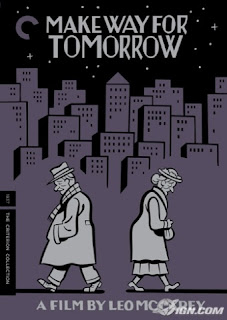
I'm still not able to shake the sadness of Leo McCarey's Make Way For Tomorrow, a film that's so beautifully and achingly upsetting that I don't know if I can bear to watch it again. How often do you encounter a Hollywood film (or any film for that matter) that treats aging and the aged as a serious subject for enquiry? There's Tokyo Story (which I'm really excited to watch again this month during the BFI's Ozu retrospective, partly to see how these movies connect) and Up that spring immediately to mind, but after that I'm struggling. This is a work of art which feels utterly out of time in its approach, a film for all times in highlighting the horror and the inevitability of how the young forget their elders. Bark and Lucy are an old, loving couple who are forced to move out of their house due to debts (there's a wonderful and amusing subplot hinted at throughout about how the guy who's evicting them is doing so out of spite because Lucy loved Bark instead of him - man I would have loved to see that film too in McCarey screwball style a la The Awful Truth!), but none of their five children are willing to take them both in at the same time. They split up into different homes, and spend time being shifted round to their very ordinary, but utterly selfish children and their families. What's remarkable is how the audience (likely youngish) are also shifted into the position of being irked by Bark and Lucy, especially in the extremely uncomfortable scene when Lucy persistently swings in her squeaking rocking chair that disturbs the bridge class her son George's wife is hosting. This scene really understands the horror that the presence of the old bring out in the young.
That annoyance the audience feels with this doddering old woman is part of what makes it hurt so much when in the final half hour the pair meet for what looks like one final time (of course the pain of this film also stems from the world-beating acting from the two leads). Bark is being sent to the other side of the country to one of the children in California whereas Lucy will be sent knowingly but without her husband's knowledge to an old person's home after he gets on the train. (It's interesting and crucial that the reason she's being sent isn't due to her frame of mind or even her health, but because her son George and his wife have convinced themselves that their own kids wayward impulses are due to Lucy's presence in the house).
There's a great moment in the restaurant that they visit before they say goodbye to each other where it seems as if they're about to kiss, but then Lucy turns round and gives a wry smile (to the camera?) before they back away. So many great elements to this scene e.g. how Lucy and Bark are playing along with the disdain they assume is felt towards them by the characters/the audience, but of course it's a real funny and witty reflexive moment too.
I never used to be much for the way objects and paintings and music placed in the background of films (or paintings etc.) are used to symbolise what's taking place in the foreground, but that's all changed after reading Edward Snow's magisterial book on Vermeer, where he really gets in deep to his paintings and demonstrates the necessity of taking everything into account. Maybe for that reason, the most hardhitting and heartrending moment for me was in the penultimate scene when the kids are all gathered round worrying about why Bark and Lucy haven't returned for a farewell dinner (they decided to forget their children for once and enjoy themselves alone). They begin to realise how much they've neglected their parents and right there, just above their heads is Jean-Francois Millet's The Gleaners:

I first became aware of this wonderful painting in Agnes Varda's documentary The Gleaners and I, then last October I was lucky enough to stumble on it without prior knowledge of its location in the Musee D'Orsay in Paris (I'd mainly gone to see the Courbet's). Bam!
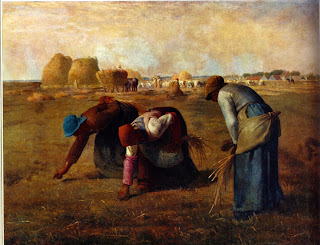
This painting is a stunner and it relates so perfectly to Lucy and Bark and the way the viewer responds to the film - first you glance at the painting and they look crippled, like hunchbacks even. But then you really get into the painting and you see the strength in their posture, strong backs and arms, sturdy and proud. Then you imagine these women out in the field every day, gleaning wheat, and they appear as if heroic statues. They're just like Lucy and Bark, oscillating in the viewer's mind between pathetic and heroic, all dependent on the way that you look at them. The great achievement of Make Way For Tomorrow is in showing us the right way to look.
This film isn't yet available on DVD so I made do and watched on Youtube here. The image and sound quality are fairly strong, but as you'd expect it's a soft image and there's occasional grain. Afterwards I was reading about the film online and whaddayaknow it's actually going to be released by Criterion next month with lovely cover art by cartoonist Seth (the pic at the top of this post). Maybe I'll buy it if I can bear the pain a second time, but you, if you haven't seen it, you must!

I'm still not able to shake the sadness of Leo McCarey's Make Way For Tomorrow, a film that's so beautifully and achingly upsetting that I don't know if I can bear to watch it again. How often do you encounter a Hollywood film (or any film for that matter) that treats aging and the aged as a serious subject for enquiry? There's Tokyo Story (which I'm really excited to watch again this month during the BFI's Ozu retrospective, partly to see how these movies connect) and Up that spring immediately to mind, but after that I'm struggling. This is a work of art which feels utterly out of time in its approach, a film for all times in highlighting the horror and the inevitability of how the young forget their elders. Bark and Lucy are an old, loving couple who are forced to move out of their house due to debts (there's a wonderful and amusing subplot hinted at throughout about how the guy who's evicting them is doing so out of spite because Lucy loved Bark instead of him - man I would have loved to see that film too in McCarey screwball style a la The Awful Truth!), but none of their five children are willing to take them both in at the same time. They split up into different homes, and spend time being shifted round to their very ordinary, but utterly selfish children and their families. What's remarkable is how the audience (likely youngish) are also shifted into the position of being irked by Bark and Lucy, especially in the extremely uncomfortable scene when Lucy persistently swings in her squeaking rocking chair that disturbs the bridge class her son George's wife is hosting. This scene really understands the horror that the presence of the old bring out in the young.
That annoyance the audience feels with this doddering old woman is part of what makes it hurt so much when in the final half hour the pair meet for what looks like one final time (of course the pain of this film also stems from the world-beating acting from the two leads). Bark is being sent to the other side of the country to one of the children in California whereas Lucy will be sent knowingly but without her husband's knowledge to an old person's home after he gets on the train. (It's interesting and crucial that the reason she's being sent isn't due to her frame of mind or even her health, but because her son George and his wife have convinced themselves that their own kids wayward impulses are due to Lucy's presence in the house).
There's a great moment in the restaurant that they visit before they say goodbye to each other where it seems as if they're about to kiss, but then Lucy turns round and gives a wry smile (to the camera?) before they back away. So many great elements to this scene e.g. how Lucy and Bark are playing along with the disdain they assume is felt towards them by the characters/the audience, but of course it's a real funny and witty reflexive moment too.
I never used to be much for the way objects and paintings and music placed in the background of films (or paintings etc.) are used to symbolise what's taking place in the foreground, but that's all changed after reading Edward Snow's magisterial book on Vermeer, where he really gets in deep to his paintings and demonstrates the necessity of taking everything into account. Maybe for that reason, the most hardhitting and heartrending moment for me was in the penultimate scene when the kids are all gathered round worrying about why Bark and Lucy haven't returned for a farewell dinner (they decided to forget their children for once and enjoy themselves alone). They begin to realise how much they've neglected their parents and right there, just above their heads is Jean-Francois Millet's The Gleaners:

I first became aware of this wonderful painting in Agnes Varda's documentary The Gleaners and I, then last October I was lucky enough to stumble on it without prior knowledge of its location in the Musee D'Orsay in Paris (I'd mainly gone to see the Courbet's). Bam!

This painting is a stunner and it relates so perfectly to Lucy and Bark and the way the viewer responds to the film - first you glance at the painting and they look crippled, like hunchbacks even. But then you really get into the painting and you see the strength in their posture, strong backs and arms, sturdy and proud. Then you imagine these women out in the field every day, gleaning wheat, and they appear as if heroic statues. They're just like Lucy and Bark, oscillating in the viewer's mind between pathetic and heroic, all dependent on the way that you look at them. The great achievement of Make Way For Tomorrow is in showing us the right way to look.
This film isn't yet available on DVD so I made do and watched on Youtube here. The image and sound quality are fairly strong, but as you'd expect it's a soft image and there's occasional grain. Afterwards I was reading about the film online and whaddayaknow it's actually going to be released by Criterion next month with lovely cover art by cartoonist Seth (the pic at the top of this post). Maybe I'll buy it if I can bear the pain a second time, but you, if you haven't seen it, you must!
Friday, January 01, 2010
The Gold Diggers (Potter)

The Gold Diggers is the debut feature length film directed by Sally Potter, a deeply mysterious and staggeringly beautiful work that follows the quests of two women as they seek answers to two connected riddles. Ruby (Julie Christie) is an actress who begins asking questions about her identity when she meets Celeste (Colette Laffont), a typist in the City who makes enquiries of her own about what lies behind the figures she works with. The narrative is always ambiguous, but The Gold Diggers is extremely direct in its sustained interrogations into notions of female performativity, as well as the connections between money, gold, and women, all objects of exchange.
Like many debut features The Gold Diggers contains a riot of cinematic cross-referencing, but Potter’s skill is in her ability to offer a critique of the films that have obviously inspired her. The all-female crew acts as a rejoinder to the male world of filmmaking, and the results of Potter’s collaborations are breathtaking. Babette Mangolte’s stunning black and white photography brings out the beauty of the unfamiliar worlds Ruby and Celeste enter into, and Lindsay Cooper’s score is so in tune with the actor’s movements that it keeps the film constantly on the edge of becoming a musical.
This BFI release is the first time the film has appeared on DVD, and it’s accompanied by five early short films that demonstrate how Potter’s vision bloomed into the main feature. The 60 page booklet includes appreciations by Jonathan Rosenbaum and Sophie Mayer, as well as a long interview with the director.
Friday, November 13, 2009
Sunshine Cleaning (Jeffs)

For all its claims to being a realistic look at life for a working class single mum in small town America, Sunshine Cleaning is a fantastical, revoltingly glossy film that looks down on its characters and their predicaments. When Rose decides that her son's route to happiness and success is dependent on him going to private school, she enlists the help of her slacker sister Norah and together they decide to set up a crime scene clean up company to raise funds. The narrative briskly sidesteps the problems a woman such as Rose might encounter in setting up a business, racing on to plenty of jovial icky moments about how awful it is to clean up the blood of a recent suicide. There's also time for philosophical reflection that work in this industry leads one to consider: "it feels wrong that we're throwing everything away - it's like we're erasing her".
Whenever the sisters walk into a house that appears to need an arduous and tiring clean the filmmakers quickly utilise the Sundance aesthetic of bright lights, snappy edits, and indie soundtracking to montage their way out of darker territory. There's a similarly clinical feel in the continual striving to balance moments of humour with a sadder, more wistful tone that quickly saps all energy from the narrative. The characterisation is paper-thin and dreadfully tiresome, with the requisite fuckups and breakdowns appearing at exactly the moment you'd expect. This facile and inane drama is aimed squarely at the middle classes, purporting to reveal what life is like for those on the bottom, but ensuring that they be beautiful, upwardly mobile people for whom success and happiness is easily achievable if only one can believe in the American dream.
Whenever the sisters walk into a house that appears to need an arduous and tiring clean the filmmakers quickly utilise the Sundance aesthetic of bright lights, snappy edits, and indie soundtracking to montage their way out of darker territory. There's a similarly clinical feel in the continual striving to balance moments of humour with a sadder, more wistful tone that quickly saps all energy from the narrative. The characterisation is paper-thin and dreadfully tiresome, with the requisite fuckups and breakdowns appearing at exactly the moment you'd expect. This facile and inane drama is aimed squarely at the middle classes, purporting to reveal what life is like for those on the bottom, but ensuring that they be beautiful, upwardly mobile people for whom success and happiness is easily achievable if only one can believe in the American dream.
Friday, October 16, 2009
Interview With Pedro Costa
 Pedro Costa was in London earlier this month to coincide with a period of increasing interest in his work. His debut feature Blood (1989) was recently released by Second Run on DVD and a complete retrospective of his films was held over two weekends at Tate Modern. Such a retrospective is the ideal setting for these beautiful and challenging films, particularly as a means to track the stylistic developments and common threads that run throughout his career.
Blood is Costa's most classical film, a noirish tale shot in rich chiaroscuro that channels the spirit of many of the director's influences, from Murnau to Tourneur to Bresson, and introduces the interest in families and place that pervades each of his films. Costa's focus has since turned towards the poor immigrants from the former Portuguese colony of Cape Verde and the Fontainhas slum on the outskirts of Lisbon where many of these people were subsequently relocated to.
After Down to Earth (1994) and Bones (1997) Costa moved away from using a full film crew and went to stay with some of the people living in Fontainhas for long stretches of time, filming hundreds of hours of footage over many months as they played semi-fictionalised versions of themselves. This led to In Vanda's Room (2000) and Colossal Youth (2006), two masterpieces that magically and devastatingly transform truth and fiction into new realms, creating a blisteringly direct portrait of a community whose inhabitants still retain their mystery.
Costa has also made two documentaries. Where Does Your Hidden Smile Lie? (2001) observes Jean-Marie Straub and Daniele Huillet during the editing process of their film Sicilia! and his most recent film is Ne Change Rien (2009), which follows the French actress and singer Jeanne Balibar as she rehearses, records an album, and performs her music live.
Do you enjoy attending retrospectives and talking about your films?
Yes, because when you talk about something you learn a lot and find yourself saying things you'd never thought about. I try not to be repetitive and instead go a little bit further and try and discover something new. In a situation like this retrospective at the Tate I'm relating and making connections between the films so that's nice for me too, and is one of the best parts of having the films shown together.
So it becomes part of the process to help you move on to the next film?
That's especially true in my case because my films are now like Chinese boxes. There's an obvious connection because I use the same people and shoot in the same place. Sometimes I discover there was something I'd never thought about at length, where just a word in a film can give you an idea. It's a little bit like how with Colossal Youth the French title is not that at all, it's Youth on the March. For me that's like a metaphor of the process, walking and thinking. Making films is also a way of walking. It's nice to have a programme that's not only for the audiences but also for me, even if I don't see the films themselves.
Do you ever go back and watch your own films?
I never watch them again. There's only one I'm more or less comfortable watching, and that's the film I made about Straub and Huillet. I can always learn from them.
Did you go to film school?
I was in film school when I was young but I hated it. I went there to learn about lenses, editing, how things work, but not theory or film history. I don't think film history is the crap we've been told. You read that Chaplin is old or that there is a chronology. With theory of course there are great people writing, but sometimes it's not the film critics, it can be a philosopher, sometimes it’s a musician, or maybe it's a poet that gives us the best text.
What were your interests growing up?
My first project was music. I was lucky when I was younger because there were a lot of things happening, the excitement of so many great bands with great lyrics. At the time the experience of listening to something by Wire and PiL was amazing. It was like seeing a Godard film. It was another world where you would get out of the movie theatre. It was a time when the person next door would probably do something amazing, but it wasn't a commercial competition. There was also a political revolution in Portugal at the same time, where the fascist dictatorship ended and the streets were full of anarchists, communists, and socialists, so from the ages of 13 to 22 I had everything, the music, the cinema, the politics, all at the same time. What this made me see was that John Ford was a hundred thousand times more progressive and communist than so called left wing documentaries saying things like “film is a gun”, and “change the world”. It was Ozu and Mizoguchi and Ford that were saying that really, you just had to be patient and see it well.
What was about these filmmakers that inspired you?
I'm very attached to a beautiful formula written by Serge Daney, one of the best French critics who I had two or three classes with in Lisbon. He said that with the movies that we like, it is the films that see us. Of course it is you that is watching the film, but the film sees you, it watches you grow up. The film tells you something, to live this way and talk that way. I knew I would like to live in the worlds that some filmmakers showed me, and I could also see immediately that certain films were not for me, because they weren't watching me. It's a very beautiful formula, maybe a bit vague or poetic, but you feel it immediately. Films by Straub and Godard knew what I was feeling. It's something you recognise, it's like a sect, a club. You feel like you belong to this club and not the other one. With my own films it's the same feeling. If it feels right it is like the images and the sounds are watching you and protecting you, showing you the way to do this or that. It's not the script, it's not your ideas. It's something more real and integrated and in time. It's more in life.
How did you come to make Ne Change Rien?
I thought this film was going to be very special and different from the others I've made, but in the end the ideas and the form are not really so unlike all the things I've been doing. It began as a friendship with Jeanne Balibar. We met seven or eight years ago at a film festival. We were always watching films together and discovered a common sensibility, and then one day she asked me to do a video for a song off her first album. The idea then came for me to be there while she was rehearsing. When I filmed her in concert I didn't want to do a film like Shine a Light with the camera turning upside down, and I wasn't interested in doing a 'making of' that you have on DVDs with guys in the studio telling jokes and drinking beer.
How did your approach for this film compare to the documentary you made about Straub and Huillet?
When I was there with Jeanne and the musicians I had the same approach as with the other film, discreetly moving around with very small equipment, being really close without disturbing them and trying to keep an eye on what's happening in the microsecond. It's so small that the moment where you cut is the time when something happens. It's so small that you miss it. For both films it was the same fascination because I was watching people I like. What I'm doing is turning these guys into monuments. It's almost like doing a fiction film because you want them to come out so good, like actors, where you can cut off all the bad parts and the things they don't do so well. I want Straub and Balibar to be bigger than life, bigger than themselves and bigger than the image you have of them. The structure I made is very fictional because they have to come out like heroes, like the great people I always thought they are, and there was no disappointment.
What was the shooting process like for In Vanda's Room and Colossal Youth, the two films you've made without a film crew?
The shooting takes a very long time, and this changes everything for me. For Colossal Youth we shot every day for two years except on Sundays. I felt for the first time in my life like I was working. I made my first films in five or six weeks and it was a luxury environment I was uncomfortable with. I thought I was too slow to make a film in this time. I always had the feeling that in the last week of shooting I would begin to start discovering the film, realising that we had done everything wrong, so I would have to be asking the producer to give me two or three more days. Of course it's not that I'm really a slow filmmaker, but that I just don't want the shooting to end. I want the complication of life to be a part of the film, to make the film. When we started filming Colossal Youth Vanda told me she was pregnant, and a year later her child ended up appearing in the last shot of the film. Of course you can't script this or suggest such an idea to a producer!
How did you persuade the inhabitants of Fontainhas to let you stay with them and film them for so long?
I had to show them that the film could be possible in another way, without a film crew and the trucks and the money, that it could be possible for me alone with a camera. They had to see how difficult it was for me. They had to see that I came at 9am when they opened the coffee shop and the barber shop and that at 7pm I would close the door. I had to show them it was a common street. That was decisive.
Did you feel conflicted about making In Vanda’s Room when there are so many drugs around?
Vanda has been into drugs since she was 15 and it's something you can't avoid. It's daily life. She smokes heroin and cocaine like I smoke cigarettes, so if you're with her for an hour you have to see it. For me as a filmmaker, there was a moment where there was an ethical problem that I dealt with silently and alone, asking how it could be done. It's not that I want to show the drugs, but I cannot avoid it, and so In Vanda's Room tries to be something else in terms of production and organisation. I am trying to do something more human though. It was not going to be a film about drugs. It was about the place, about the room, about a kind of family and a world seen through my eyes. It's not the real Fontainhas or the real Vanda, but it's my eyes seeing her and her watching me. A lot of people dislike In Vanda's Room because they don't feel I have the right to film those people that way. I've been accused that the film is too beautiful and criticised because we don't explain how they get the money to buy drugs, but that's simply because money doesn't have a value there. They don't have money and so they have to find it, and normally they find the money and then they spend it immediately on drugs. It goes up in the air.
In most films that show junkies the camera will start turning as soon as they start smoking and we go into this daze and the characters get stupid. For me this was not the case. They were always thinking about serious things. I did not think and plan all this. I just said let it be, knowing that drugs will be there for Vanda and for a lot of people, but taking care that we were not going to make films like anyone else and that these people will think and talk like other people. A lot of documentary filmmakers think you have to make an ugly film, that ethically I have no right to turn them into heroes, but that's what I wanted. The lesson I learnt from Chaplin and Ford is that people have to walk out better than they walk in. Ventura has to be bigger than John Wayne.
How do you determine the right distance to keep when you're filming?
I don't believe a camera can solve or discover the mystery of anybody. It's very fake, so I don't pretend I'm close. The distance I keep is just a focal thing, it's not meant to say I know this person and I want you to feel how he's feeling. In the case of Ventura the distance is something I cannot avoid. I could never say I understand him or I know what he felt. I'm not black like Ventura or from the same social class. I was not born on Cape Verde and I've never been 20 years into taking Cocaine, and they tend to tell me that every second. He said to me at the end of shooting very simply, “don't ever think you can know me because you have a camera”. I think that's one of the best principles and lessons you can learn to make film, to think about the distance that will be created between you and what you want to film, and perhaps accepting that it’s very wide between me and him, a deep and long everlasting ocean of mystery that neither of us will cross. But of course that doesn't mean that he's not interested in the work. It doesn't mean that we're not friends.
Do you plan to work with these people again?
It's their expectation. When a film is almost over we're ready for the next one. It's about them demanding something, and I've no reason to go away. I think my next film with them will be about young kids, a younger generation. In the last shot of Colossal Youth Ventura is lying on a bed more or less moaning something and Vanda's newly born daughter is beside him making some sounds, and I thought that this is probably a good dialogue. I take it as a sign that Ventura finally rests and this new face appears and has this strange coded language that we don't understand.
Can you speak about the films you chose to accompany the retrospective at the Tate?
If I do this kind of thing it's about giving the viewer tools that are really proposals saying 'you can do a film this way'. In the case of Jean-Pierre Gorin's Routine Pleasures it's a shoestring budget, two guys and that's it. With the Jean Eustache film The Pig you see the most amazing way of watching a very ancient ritual of killing a pig, and you see it's really about the people, not about the animal. I chose Straub for more practical reasons, because Sicilia! is the film that I documented the editing of in Where Does Your Hidden Smile Lie? Straub and Huillet are the filmmakers that give you the feeling that films are meant to be worth something. The Warhol film I show is called Beauty, a film I saw recently and it's just like In Vanda's Room, the difference being that he made it without thinking for one second whereas I took two years of pain and blood.
Monday, August 10, 2009
Notes on Zabriskie Point
 Beauty
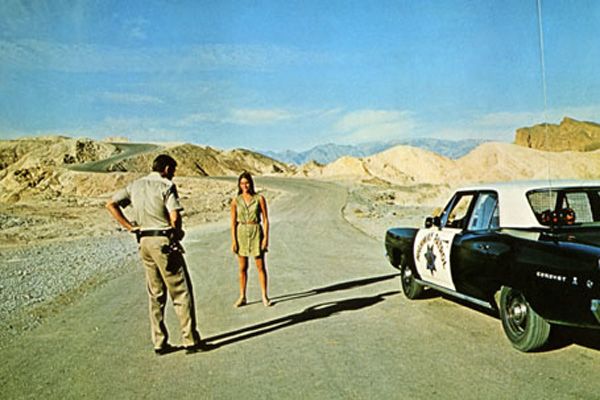
Zabriskie Point is a film of astonishing beauty. Antonioni has the ability to place a series of landscapes, objects, or (most importantly) faces in a majestic arrangement of patterns that send me into an oneiric trance. The success of his films depend on this, because it’s essential that the dreamy turns his narratives take (orgies in the desert, exploding houses, magically appearing men with magically appearing cans of paint) appear natural to the development of the film, so that these ruptures aren’t an abandonment of narrative logic but work as a development of Antonioni’s unique mode of storytelling. Narrative is not left behind in his films; it just heads to unexpected places. One becomes wowed by the beauty the frame contains, and astonished by the way Antonioni frames it, so that the car, the mountains, hair, fire, a TV set, and on and on, all become interchangeable. A landscape is a face, a face is an object, an object is a landscape.
Acting
Are Mark Frechette and Daria Halprin bad actors? It depends on your definition of the word bad. There’s no doubt that the way they move through the landscape feels unreal, that their voices are stilted and that most traces of charisma have been scooped out of them. But if we see them less as actors and more as models, their casting makes perfect sense. Mark and Daria are important because of what they represent, not because of what they are. It is essential that they behave as vacantly as the faces adorning the endless billboards in the city and as blank as the parched landscape of Death Valley.
Escape
Zabriskie Point is deeply concerned with the futile desire to escape. Wherever these bodies move, Antonioni ensures that they are always folded into a landscape or set off against it. In the city their bodies are framed in tight close up, the camera whizzing past people as they mesh together in a haze, whilst their voices swell to one long, unrelenting rumble. The city is jammed full of adverts, on billboards and TV and radio, rendering all bodies lost in a sea of information. The move to the desert leads the camera further away and higher up, turning them into insects as they yet again disappear into their surroundings.
Suspense
The famous scene from North By Northwest in which Cary Grant is attacked by a mysterious jet in a vast expanse of Indiana countryside finds its modernist echo in Zabriskie Point. The suspense is drained. Animated peril transforms into a vacant smile.
Utopia
Is the desert a utopia? This article published in Senses of Cinema suggests so, and tends to reduce the film into a series of binary oppositions in which the city/cops = bad and desert/students = good. This sort of attitude not only dampens the power of this film but short changes the complexities within. For sure the film falls cleanly on the side of the students, but Mark’s boyish adventure into the desert is hardly a revolutionary act. Daria prefers to listen to rock music than be politically active, and her final act of defiance is shrouded in fantasy. There are policemen in the desert and students in the city, and while the orgy takes place there is a reality that exists a few miles away.
Endings
Reaching out towards a pure cinema:
Subscribe to:
Posts (Atom)

